
News
Smart Learning: Improving Comfort & Accessibility in Educational Institutions
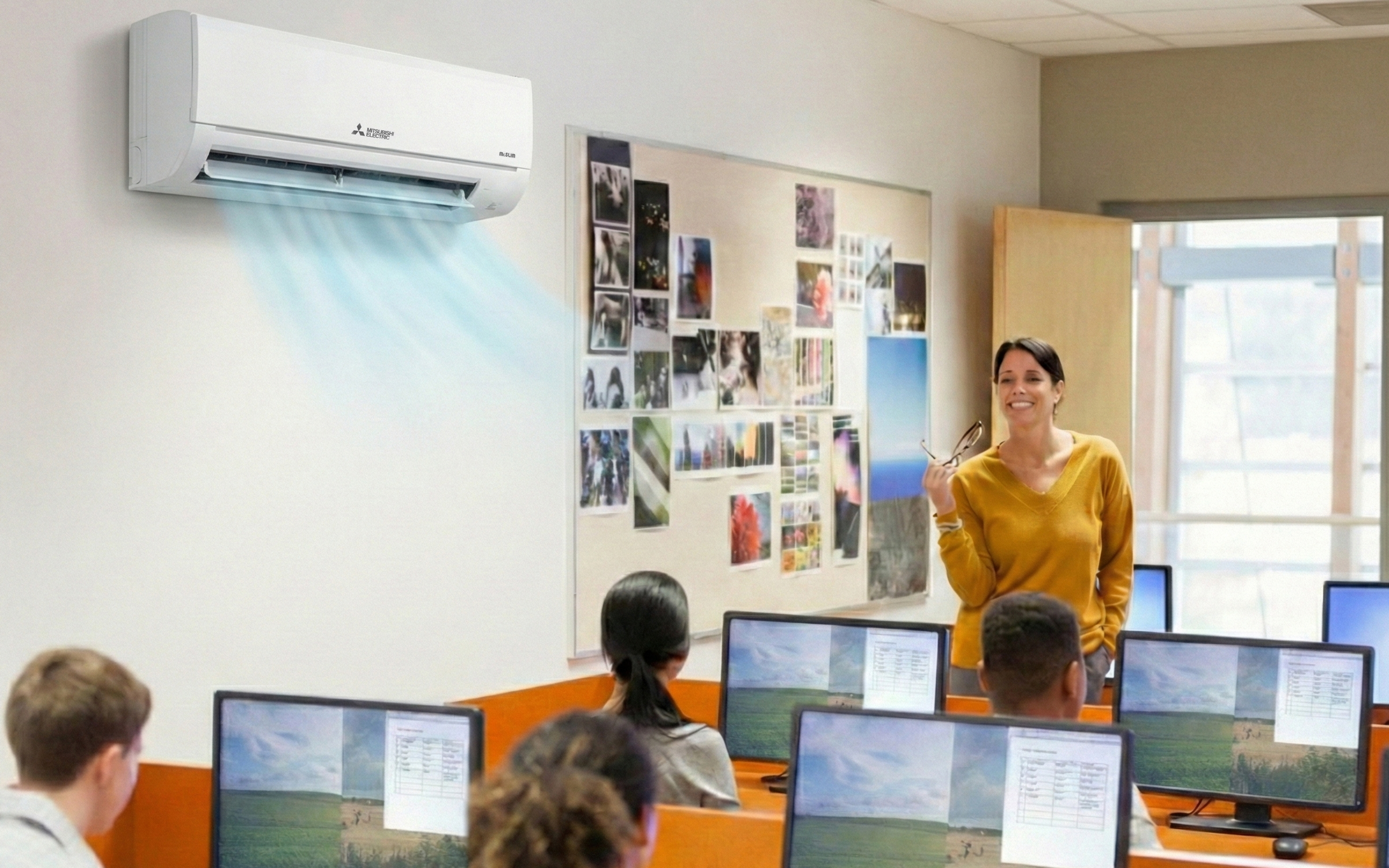
We design campuses around people. In schools and universities, every minute is important, and that is why at International Elevator & Equipment, Inc. (IEE), we strive to remove the usual attention thieves—such as heat, humidity, long queues, and hard-to-reach floors—through innovative Mitsubishi Electric technologies. In the Philippines, the average monthly relative humidity is from 71% in March to 85% in September1, thus classrooms may become unpleasant when indoor air quality is not well-managed.
When these frictions are resolved, education becomes more stress-free, and students are able to pay more attention to what truly matters. That is when the building's amenities, including but not limited to air conditioning systems, elevators, and building automation, begin to foster better learning.
Comfort That Adapts to Every Individual
Comfort is not "one setting for all." Learners, educators, and school personnel alike could be prone to headaches in stuffy rooms and may have asthma or sensory needs. Many people also rely on wheelchairs, crutches, and mobility aids. According to the 2020 Census, 8.47 million Filipinos, or 8.7% of those five and older, have at least one functional difficulty.2 In recognizing these realities, schools and campuses must address the need to create safer, more inclusive environments through high-quality air conditioning systems and elevators. Comfort and accessibility must be made the default—for everyone.
Empathy is in the details, and by enabling quiet system operations, stable cooling, as well as improved mobility throughout educational institutions, we help create better learning environments for all.
Indoor Air Quality That Helps Students Focus
Indoor air quality affects how we think. Research links higher classroom carbon dioxide levels and poor ventilation with lower attention and weaker academic performance.3 Similarly, public health guidance treats ventilation as a way to keep indoor spaces healthier. In the Philippines, moisture control is also important for preventing mold buildup, structural damage, and health-related incidents such as allergy flare-ups. Hence, heating, ventilation, and air conditioning (HVAC) is best implemented as a whole-building system, ensuring effective climate control in every applicable area.
Mr. SLIM Inverter Series for Efficient Cooling
Along these lines, we offer the Mr. SLIM Inverter Series for use in classrooms, clinics, and offices. Its inverter technology varies compressor speed to match the actual heat load, instead of repeatedly turning completely on and off. This prevents sudden temperature swings that can distract students and make rooms feel “too cold” or “too warm” during class. It also keeps operations steady and quiet, and educators need not worry about competing with equipment noise for their students’ attention. Many Mitsubishi Electric air conditioners are also powered by the ozone-friendly R-32 refrigerant, favored for its low global warming potential.t
Accessibility That Keeps the Day Moving
Accessibility is also about time. Students should not have to miss class because of limited mobility options, such as crowded stairs, especially when traveling to higher levels. Similarly, staff should not have to dread moving teaching aids between floors, nor should any building occupant feel excluded due to a lack of accessible modes of transport.
Elevators make it easier for more people to move within multilevel buildings, in addition to enhancing safety by reducing the risk of accidents. Not only that, but they also help move larger groups of people during hectic periods, such as during examinations or enrollment processes.
ELENESSA and NEXIEZ-MRL for Smarter Vertical Transport
At IEE, we engineer elevators to fit the flow of a campus. ELENESSA (Series-IP Version2) utilizes unconventional group control, including AI Neural Network-based allocation, to cut down on wait times during busy hours. On the other hand, NEXIEZ-MRL makes floor-to-floor travel more efficient with our industry-first variable traveling speed elevator system, through which the elevator car may travel more swiftly depending on its passenger load. These groundbreaking features help ease the movement from classroom to classroom and streamline foot traffic in lobbies and doorways.
MELSAFETY-PA for a Safer, Calmer Campus
For a calmer ambiance, security must be strong but discreet, serving its purpose without adding to distractions. Our MELSAFETY-PA is an access control system that fortifies campus safety by centralizing controls on who can use the elevators. This protects students, staff, guests, and school equipment at no disadvantage to them. MELSAFETY-PA can also store access and alarm logs, which support clearer incident review and accountability. If done right, this can create a safer yet still welcoming campus.
Create Comfortable, Accessible Campuses for Learners
Smart buildings support smart learning. When air conditioning systems are efficient, indoor air quality and comfort are easier to maintain. When elevators are dependable, accessibility becomes the standard. Similarly, when access control is modernized, safety becomes part of organizational culture. That is innovation with social responsibility, pursuant to the “Changes for the Better” we seek to make at IEE through Mitsubishi Electric building solutions across educational institutions everywhere.
1Philippine Atmospheric, Geophysical and Astronomical Services Administration (PAGASA). “Climate of the Philippines.” https://www.pagasa.dost.gov.ph/information/climate-philippines
2United Nations Children’s Fund (UNICEF) Philippines. Promoting Inclusive Disability Registration in the Philippines: Policy Brief. July 2024. https://www.unicef.org/philippines/media/9421/file/Disability%20Registration%20Policy%20Brief%20FINAL.pdf.pdf
3Manuela Pulimeno et al., “Indoor Air Quality at School and Students’ Performance: Recommendations of the UNESCO Chair on Health Education and Sustainable Development & the Italian Society of Environmental Medicine (SIMA),” Health Promotion Perspectives 10, no. 3 (July 12, 2020): 169–74, Accessed January 8, 2026. https://doi.org/10.34172/hpp.2020.29.